Samuel Carbis & Mary Ann Logan
Samuel Carbis was born in 1813 in Cornwall, England to Samuel Carbis and Jane Jory. At the age of nine, he packed his bundle and ran away, signing on a ship as a cabin boy. Samuel sailed the seas for more than a decade until 1835 when he came west to America and started steamboating.
Mary Ann was born into a farming community in Huntingdon County, Pennsylvania and as a young girl moved with her family to Pittsburgh. Mary Ann’s father was a ‘ne’re do well’ who served two terms in Western State Penitentiary in Pittsburgh during the late 1820’s and early 1830’s.
Samuel and Mary Ann met in the late 1830’s, most likely in Pittsburgh, and were married on July 30, 1839. Although Samuel traveled a lot and had a second residence in St. Louis, Mary Ann remained in Pittsburgh and raised their family. Together, the couple had nine children with six (Margaret, Virginia, Anna, Pauline, Julia and Henry) surviving childhood. A son George and two others unknown died as children.
Samuel was a colorful individual who experienced numerous adventures during his more than 40 year steamboating career. He worked the Missouri river from Fort Benson to the Mississippi, and the Mississippi river from the Gulf to Minneapolis, he also ran the Ohio, Cumberland, Wabash, and Kentucky rivers. Sam went over the falls in Louisville in 1840 in an old time coal boat and thought for sure he wouldn’t make it out alive. Despite being unable to swim, he survived the sinking of nine ships quipping – “I can’t swim a lick, but I got through all right, and that’s what makes me think I wasn’t born to be drowned”. But despite the dangers of sinking, the biggest fear on riverboats was the potential for a boiler explosion. Many lives were lost during the steamboat era from explosions, and these explosions were more likely on fast moving rivers like the Mississippi and Missouri. Steamboats elsewhere utilized low-pressure boilers, but the swift currents on the western rivers required high-pressure boilers which were more prone to explosion. Samuel credited the “little cherub that sits aloft and watches out for Jack the sailor” for his amazing luck in narrowly avoiding death from explosion. He accidentally missed a trip in February of 1858 on the Col. Crossman, and on that voyage its boilers exploded killing 14 people. A year later he wasn’t feeling well and laid off a trip on the St. Nicholas when it exploded. Another time he staid off the Alvin T Tracey due to a disagreement about wages and she never made it back because “her boilers made driftwood out of her”.
On May 17, 1849, Sam was was serving as Mate on the Alice in St. Louis. At 9:00 pm the city’s fire alarm sounded in response to a fire aboard the steamboat White Cloud which was docked at the foot of Cherry Street. The local volunteer fire department promptly responded but before they could get it under control, the fire burnt through the moorings holding the ship and it drifted down river where it set over two dozen ships on fire. The Alice had three kegs of powder on board. When it looked like she would catch fire, Sam and another man went on board and Sam threw two of the kegs in the river while the other man put the last keg on the Levee. When the Alice did catch fire, Sam ran on board to retrieve his vest which held his month’s wages in a pocket. As he came out, the keg on the levee exploded and Sam, thrown by the force of the explosion, was blinded for nearly three months. As his friends rushed to tend to him, the fire continued to rage and leaped from the burning steamboats to the buildings on shore and soon everything on the levee for four blocks was burning. The fire burned for hours and destroyed block after block of the city. Demoralized, the fire department decided to take drastic measures and preemptively blew up six businesses in a line in front of the fire to keep it from spreading. When all was said and done, 39 ships including 23 steamboats, and 430 buildings were destroyed. It was the largest and most destructive fire St. Louis ever experienced.
Sam bounced back and continued steamboating. He worked on the deck of many steamboats and was efficient at barking orders to the dockhands in a deep, decided voice, often using colorful language. During the heyday of steamboating, before the railroads became the main form of transportation, steamboat crews made good money. Sam routinely brought home $250 a month and once brought home $300 a month. Mary Ann and the kids lived well in the East Liberty section of Pittsburgh and Sam was able to have a second residence in St. Louis. Mary Ann, devout Catholic that she was, was able to provide generous remittance payments to St. Peter and St. Paul’s Church.
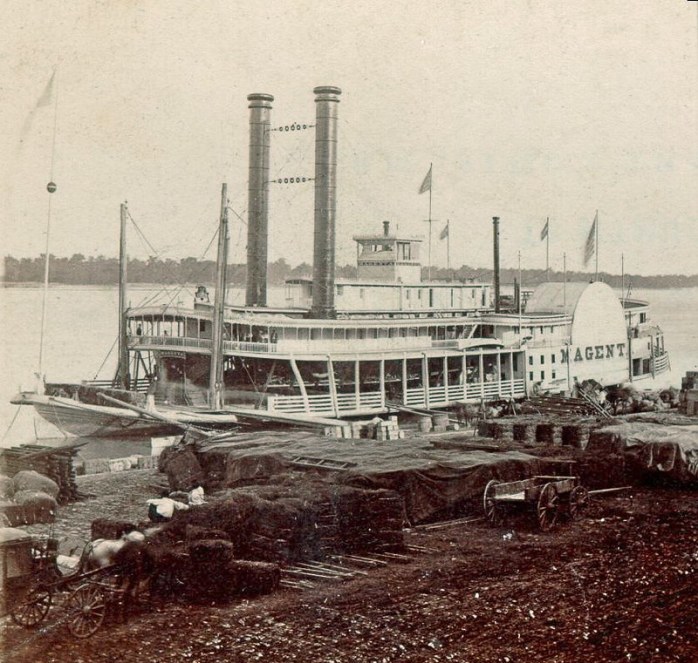
In 1862, Sam found himself exempt from registering from military duty in St. Louis because he was deemed “over age”. This did not exempt him from experiencing hardships however, and the years during the Civil War were tough. The Union Army controlled the rivers and essentially impressed or chartered civilian vessels into their service. Pay was low and the entire crew was subject to military discipline. As civilians, the crew were not subject to military pension yet they were subject to military discipline, including court martial or lashing. This treatment resulted in friction between the soldiers and civilians who served together. Samuel’s experience was no different. While serving as Mate of the Magenta in May of 1865, towards the end of the War, he was arrested by the Union Provost Marshal in St. Louis and put into Gratiot Street Prison. His stay was brief as his bond was paid and he remained in the city, reporting daily to the Provost Marshal until his trial. His arrest certificate says that “…Carbis has been arrested on the charge of disloyal conduct and practices in refusing soldiers of the U.S. Army privileges on said steamer ‘Magenta’ and extending to Rebel soldiers privileges refused to said soldiers of the United States and in encouraging and permitting Rebels to use disloyal language on said steamboat, and has been discharged from imprisonment upon his Parole and this bond.” He must have behaved after that because no other records were found.
Shortly after the war, Samuel placed an ad in a newspaper in Cornwall, England looking for any living members of his family. It is unknown whether anyone replied.
1872 was a tough year for the family. In July while in St. Louis, Samuel and a friend went to the saloon of David Capt at the corner of Main and Elm streets where they each enjoyed a glass of beer. As they finished their beers, an intoxicated “steamboat roustabout” named Thomas Martin entered the bar. Conflicting stories exist about what happened next, but some type of altercation occurred. Upon leaving the bar, Samuel was followed into the street by Thomas who attacked him from behind stabbing him with a knife in the shoulder, back, arm, and abdomen. Bleeding profusely and undoubtedly in much pain, Sam was helped to a nearby drugstore by two officers where he received surgical attention. He was then taken to his home at 309 South Third Street to await his fate. He survived the incident and returned to work but a few months later he and Mary Ann were grieving the death of their oldest daughter Maggie at the age of 31. In 1856, Maggie had married Pilot Henry Kerlin in St. Louis and they named their son Samuel after Maggie’s father. Henry died in 1858 at the age of 22 and after her second marriage to John Joyce, Maggie and Henry’s son Samuel moved in with Mary Ann and Sam. They must have been close to Henry because when their last child (a son) was born in 1862, they named him Henry, presumably after him. After Maggie’s death, they took in her three children from her second marriage to John Joyce prompting John to file for custody in court claiming that the children were being unlawfully held by Samuel. Losing Maggie, then having to turn the grandchildren over to their father must have been very trying for them.
Sam continued boating and Mary Ann devoted herself to her children, grand-children, and church. Their grandson Samuel Kerlin started a farm in Burrell, Pennsylvania and she and Henry would go visit. Shortly after 1880, Samuel Carbis retired to Pittsburgh and lived on Hatfield, just north of Fifteenth Street. Although Mary Ann was Catholic, Samuel had refused to be baptized while working the river. He claimed that in his position as river boat mate he would have to use strong language to his “darkies” and mules, and that he could not reconcile becoming Catholic while using such obscene language. It wasn’t until he was on his deathbed that Samuel agreed to be baptized Catholic. He died in 1884.
Mary Ann spent the remaining twenty plus years of her life devoted to her children and grand-children, eventually relocating to Derry in Westmoreland County to live with her daughter Pauline and her family. She passed away in 1909 at the age of 88.
 Kiera's Genealogy Page