George Smith & Catherine Fleckenstein
George Washington Schmidt was born on the anniversary of his namesake’s birthday. His parents had been planning to emigrate to the United States and chose his patriotic name for that reason. George was brought to the U.S. as a young child by his grandmother in the early 1870’s. His parents had arrived a year earlier. The family settled in Wilmore, Pennsylvania, and later moved to Johnstown. When George was enrolled in American schools, his teacher told him, “You’re in America now. Your name is Smith, not Schmidt.” While growing up in Johnstown in the 1870’s and 1880’s, he first met Catherine Fleckenstein, who lived only one block away.
Catherine (Kate) Gertrude Fleckenstein was born and raised in Johnstown. By the time she was 21, she was earning her living as a seamstress, and probably helping her father support the family. They were living at 713 Chestnut Street in Cambria City, just one block from the bank of the Conemaugh River and one-half mile below the stone bridge.
In his book “The Johnstown Flood”, David McCullough describes Johnstown in this way:
“Johnstown of 1889 was not a pretty place. But the land around it was magnificent. From Main Street, a man standing among the holiday crowds could see green hills, small mountains really, hunching in close on every side, dwarfing the tops of houses and smokestacks.
“The city was built on a nearly level flood plain at the confluence of two rivers, down at the bottom of an enormous hole in the Alleghenies. A visitor from the Middle West once commented, ‘Your sun rises at ten and sets at two’, “and it was not too great an exaggeration.
“The rivers, except in the spring, appeared to be of little consequence. The Little Conemaugh and Stony Creek, or The Stony Creek, as everyone in Johnstown has always said (since it is the Stony Creek River), are both more like rocky, oversized mountain streams than rivers. They are about sixty to eighty yards wide. Normally their current is very fast; in the spring they run wild. But on towards August, as one writer of the 1880’s said, there are places on either river where a good jumper could cross on dry stones.
“Little Conemaugh, which is the much swifter of the two, rushes in from the east, from the Allegheny Mountains. It begins near the very top of the mountain, about eighteen miles from Johnstown, at a coal town called Lilly. It’s sources are Bear Rock Run and Bear Creek, Trout Run, Bens Creek, Laurel Run, South Ford Creek, Clapboard Run and Saltlick Creek. From an elevation of 2,300 feet at Lilly, the Little Conemaugh drops 1,147 feet to Johnstown.
“The Stoney creek flows in from the south. It is a broader, deeper river than the other and is fed by streams with names like Beaver Dam Run, Fallen Timber Run, Shade Creek, and Paint Creek. Its total drainage is considerably more than that of the Little Conemaugh, and until 1889 it had always been thought to be the more dangerous of the two.
“When they meet at Johnstown, the rivers form the Conemaugh, which, farther west, joins the Loyalhanna to form the Kiskiminetas, which in turn flows into the Allegheny about eighteen miles above Pittsburgh.”
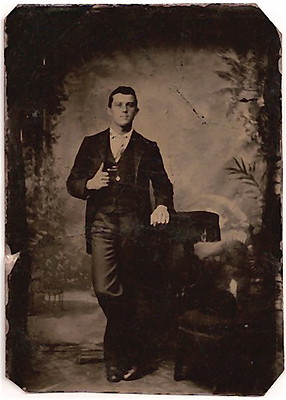
On October 12, 1887, George took a job with the Pennsylvania Railroad. He worked as a brakeman on a freight train between Johnstown and Derry. It was while he was away on one of his many trips with the railroad that Johnstown was destroyed by the great flood in 1889.
On Thursday, May 30, 1889, a fine and gentle rain began to fall about mid-afternoon. The rivers were already high from many days of rain earlier in May and short-lived but heavy snowfall in April. By late night the rain was coming down in torrents, so that by the next morning the rivers began to overflow their banks.
All about town, the people were preparing for a flood by putting valuables and such up out of the reach of the expected floodwaters. The water was rising about a foot an hour, and many streets were under water by noon. The people had experienced many such floods and considered them a minor nuisance. This time however, about eight inches of rain would fall on the mountains in one 24-hour period; the worst rainfall on record.
Kate Fleckenstein had been left home to babysit her younger brothers and sisters. And as the waters rose, they moved upstairs to wait out the flood. By now they were effectively cut off from high ground by the rising water.
Shortly after 3pm on May 31, the earthen dam at the South Fork Hunting and Fishing Club gave way. The possibility had often been talked about by the people of Johnstown, but no one apparently expected it to actually happen. The pent-up lake drained in a wild cascade of water and sent a flood surging down the valley of the Little Conemaugh. As the water raced down the valley towards Johnstown, it swept everything before it so that a wall of water and debris up to 30 feet high crashed through the town about 4 o’clock. As the flood hit the face of the mountain opposite Johnstown, the water divided into three waves. One to turn up the valley of the Stony Creek, one to bounce back on Johnstown again, and the third to turn downstream toward the Stone Bridge. As a result of the diminished force of the divided flood, the bridge held. Houses, railroad cars and other debris began to pile up and create a new dam. This debris then caught fire and many of those injured and trapped in the rubble escaped drowning, only to be burned.
Shortly before nightfall, a break occurred in the embankment at the east end of the Stone Bridge. As the water roared through this spillway, houses and debris tumbled through like boats running the rapids. Cambria City was not hit by the full force of the flood rather than just slowly rising water. House after house was torn from its foundationand swept away and dashed to pieces. Kate saw her older brother, Frank, wave to her as he was swept down the river. He had his wife, Ann, and two-year old daughter, Regina, held in his arms. His house at 220 1/2 Chestnut Street had been destroyed.
As Frank was being swept down the river, his wife and child were torn from him and drowned. Finally, eight miles below Johnstown, at Seward, he was able to crawl out of the river. He had been stripped completely naked by the raging floodwaters. As he walked back up-stream he met a farmer who gave him a raincoat and boots to wear. He later met a girl who had also been stripped by the flood, and he gave her the raincoat and boots. He then continued his walk back to Johnstown.
As the floodwaters swirled through Cambria City, two houses wedged in tight on either side of the Fleckenstein’s. It was these two houses that held Kate’s house in place so that the flood could only raise it slightly off its foundation and then lower it back in the same place.
Amid the terrible noise of debris crashing all around them, and the screams of the people trapped at the bridge, one of Kate’s sisters cried, “OH God! If I have to die, don’t let me go to Hell!”.
Night fell, lit only by the red glow from the fire at the bridge. In the darkness Kate and the others waited on the second floor of their house. With the light of morning, on June 1, it was apparent that nearly all of Johnstown had been destroyed, and at least two thirds of the houses in Cambria City had been wiped out. As the flood began to recede, tremendous piles of mud and debris were dumped everywhere.
As the Fleckensteins descended the stairs of their home, they noticed that the wooden box of the sewing machine had been washed away in the flood leaving only the cast iron base and treadle. A can of corn and a coal bucket had been placed neatly on the mantlepiece by the flood water. Locking arms, the little group left the house and began to wade towards higher ground through waist deep water, never knowing when they might step on the drowned corpses of people or livestock. The body of Kate’s young girlfriend was draped over a picket fence.
When the final count was in, over 2,000 people had been killed. Many more had been left homeless. It would take many months before the town would be cleaned and repaired, and the steel mills were operating again. In the aftermath of this disaster, Kate offered her services as a seamstress and made clothes for the mother of Bishop Hugh C. Boyle.
In 1894, George Smith and Kate Fleckenstein were married. They moved to 315 Broad Street in Derry. Their first pregnancy resulted in a miscarriage. The next child was delivered on George Washington’s birthday in 1897. Since father, son, and president all shared the same day, the baby was also baptized George Washington Smith. George and Kate’s other children were; Raymond in 1898, Mary Josephine in 1901, Marcella Catherine in 1902, James Michael in 1903, and Eva in 1909. Marcella died from disease in 1910.
On May 1, 1902 George was promoted from brakeman to conductor. In addition to working on the railroad, he also was a volunteer fireman with the local company.
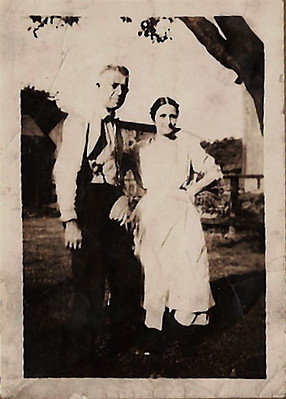
On a cold wet December evening in 1917, only three days before Christmas, George slipped while climbing on an ice-covered ladder aboard his train. He fell beneath the moving railroad car and his leg was crushed under the wheels. Although he survived, he had lost his leg. Several attempts were made to fit him with a wooded leg, but none were comfortable enough to wear. He retired from the railroad.
On October 10, 1925, the Derry fireman were having their annual carnival. And since George Smith was a retired fireman, some thought it would be nice to ask him to ride in the front of the fire truck for the parade. At first, he did not want to go, but at last he was coaxed into the ride. The atmosphere that day was charged with excitement with people cheering and waving at the parade. At one point, George slumped in his seat. Someone in the crowd said, “Look at Smitty! He’s fallen asleep.”
When the parade was over, it was realized that he had suffered a stroke. He was brought home and laid on the couch. He never regained consciousness and died that same day.
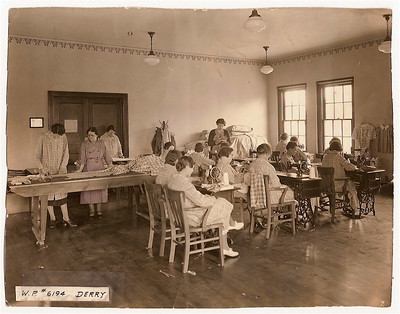
During the Great Depression of the 1930’s Kate, with her experience as a seamstress, headed a Works Progress Administration (WPA) sewing group. She was alert and good humored even into her old-age, and died peacefully in her home at 120 Start Avenue in Greensburg just five days short of her 98th birthday.
 Kiera's Genealogy Page