Frederick Kerby & Sarah Mulvilhill
Frederick Kerby was born in Bedford County, Pennsylvania to Joseph Kirby and Rosanna Mock. Just months before his birth, the County was caught up in fear that advancing Rebel forces would find their way to Bedford and work began on building defensive barricades and trenches. Luckily, Confederate forces turned east and marched to Gettysburg and Frederick was born in relative peace. He grew up and attended school in St. Clair with his older brother Alexander and his younger brother Elmer. Living in rural Pennsylvania, they boys would have had to walk to school over hilly terrain in all types of weather. To study their lessons at night, the brothers would gather underneath the tallow dip (a candle with three stands of cotton wicking and a little bit of lard sticking on a wall) to read their lessons. A true candle was a luxury, the tallow dipped candle was the usual light.
Frederick moved out while a teenager and earned a living as a farmhand for Joseph Moses while attending school. It was during this time that he saw the value of an education and applied himself to his studies. He would study at night and in his idle hours by going into a room by himself and studying “instead of running around over the streets”. It was this discipline and study that allowed him to move his way up through the railroads. Frederick and his brothers all worked for the railroad. The starting position for railroad workers was as a brakeman and Frederick started in this position. The brakeman position was extremely dangerous in the early days of the railroads as the brakes were turned by hand and located at the tops of the railroad cars. Brakemen would have to walk on top of the train cars in all weather to apply the brakes. Injuries and death due to slipping were common.
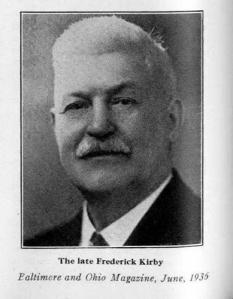
Frederick was a devoted railroad employee and a member of several railroad associations. He started his career as a Brakeman with the Pennsylvania R.R. before switching to the B & O R.R as an Engineer. The term engineer referred to the person who drove the train. Shortly thereafter he was made Air Brake Instructor, and then Road Foreman of Engines. In 1913 he was appointed Supervisor of Locomotive Operations where he remained until 1927 when he was promoted to Assistant to Chief of Motive Power and Equipment which he held until his retirement in 1934. Frederick was a member of the Brotherhood of Locomotive Engineers, the Brotherhood of Locomotive Firemen, and the Railroad Club of Pittsburgh. He was also a member of the Traveling Engineers Association and served as the organization’s president in 1923. He devoted much time and energy to these organizations where he was known to have a cheerful and friendly disposition and many friends.
Despite his lack of an advanced education, Frederick wrote and spoke extensively on a wide-range of topics for various railroad journals, organizations, and clubs. He promoted an 8-hour workday, wrote on the advantages of using speed recorders, and opined on whether a college education could replace on-the-job training.
In 1880, Frederick’s brother Alex was living in Renovo, PA where he was working as a railroad engineer. Living with Alex was his young wife, Mary, and her mother and sisters. Frederick was taken by Mary’s younger sister Sarah and the two were married shortly after. Together, Frederick and Sarah had ten children, seven of whom lived to adulthood: Isabella, Clara, Kathleen, Frederick, Maurice, James Bernard, and Elieen. The family moved around as Frederick changed positions with the railroads, living at various times in Renovo, PA, St. Mary’s, PA, and Baltimore, MD. In addition to attending school, many of the children could sing and play, using the upright piano that Frederick bought for Sarah.
In the early 1900’s, Frederick moved to Baltimore and eventually purchased a rowhouse at 917 N. Fulton Avenue. The children attended Corpus Christi parochial school.
Sarah’s mother, Mary, lived with the family until her death in 1914 at the age of 90. Sarah followed soon after, passing away in 1917 at the age of 51 from kidney disease. After Sarah’s death, Frederick married Mary L. Clark, the widow of another railroad employee and the two lived in Cumberland, MD. Frederick kept his house on Fulton Street in Baltimore and let his daughter Clara and her family reside there. Despite the stressful economic situation caused by the great depression, Frederick lived comfortably. He owned his house on Pennsylvania Avenue and even had a 1935 model Dodge sedan. Frederick suffered from high blood pressure and heart disease as well as diabetes, leading to a stroke in May of 1936. He passed away a few days later at the age of 72. After Frederick’s death, his children filed suit against his widow regarding his estate and the disbursement of his assets.
Sources:
- 1880 US Census – Pennsylvania. Bedford County. East St. Clair. ED 234. Image 12 of 26. NARA Publication Microfilm T9. Retrieved from FamilySearch.org
- 1900 US Census – Pennsylvania. Elk County. ED 43 St. Marys Borrough. Image 59 of 86. NARA Publication Microfilm T623 roll 1407. Retrieved from FamilySearch.org
- 1910 US Census – Maryland. Baltimore County. Baltimore Ward 11. ED 172. Image 13 of 16. NARA Publication Microfilm T624 roll 556. Retrieved from FamilySearch.org
- 1920 US Census – Maryland. Allegany. Cumberland Ward 4. ED 12. Image 11 of 26. NARA Publication Microfilm T625 roll 652. Retrieved from FamilySearch.org
- 1930 US Census – Maryland. Allegany. Cumberland Ward. ED 23. Image 61 of 82. NARA Publication Microfilm T626 roll 843. Retrieved from FamilySearch.org
- Maryland. Maryland State Archives. Death Certificate Number 1593 (January 21, 1917). Sarah Kirby, Baltimore City.
- Maryland. Maryland State Archives. Death Certificate Number 4731 (May 18, 1936). Frederick Kerby, Allegany County.
- St. Martins Catholic Church (Baltimore City, Maryland), “Burials 1880 – 1923” Image 70 of 82. Retrieved from Findmypast.com
- “The Journeys End” Baltimore and Ohio Magazine. June 1936. Page 32. Provided courtesy of Hays T. Watkins Research Library, Baltimore & Ohio Railroad Museum. Baltimore, MD.
- Official Proceedings of the Railway Club of Pittsburgh. Volume 26. November 1926 – October 1927. Page 64. Retrieved from Archive.org.
- “Who’s Lying About Railroad Wages” Pearson’s Magazine. (1916). Page 513. United States: Pearson Publishing Company. Retrieved from Google
 Kiera's Genealogy Page