Edward Bridge & Florence Burd

Edward Vincent Bridge was probably born near New Derry in Pennsylvania and grew up on a small farm. When he was about 11 years old, one of his older brothers deemed it necessary to punish him for some wrong that he had committed. During the “lickin” administered by his older brother, Edward suffered a severe bruise on his left hip. In spite of the soreness he refused to let anyone feel sorry for him. Shortly thereafter, he jumped down from the top of a shed and further injured his hip. As a result of one or both of these injuries, he developed osteomyelitis of the hip, a disease in which the bone partially dies and disintegrates. His left leg ceased to grow, and by the time he was an adult, his left leg was very much shorter than his right. He had a special shoe for his left leg that was built up so that he walked nearly on his toes. He was in need of a cane to help him walk and he limped very badly. Splinters of bone continuously worked their way out through the muscle and eventually broke through boils in the skin where they could be removed with tweezers. It was extremely painful and he suffered with it during his entire life.
About 1890, Edward became an apprentice photographer under Mr. R. L. Durham in Latrobe. At the age of 21, he opened his own studio in Derry. He worked with both, the early glass plate and tintype stule of photographs. He was always very precise and professional in his work. He believed that a picture would last forever if washed properly in the chemicals.

In 1902, when he was nearly 30 years old, he married Florence Baptista Burd of Derry.
Florence was a proud woman, raised in a family that considered themselves very important people in Derry. Her father was a strict man with rigid ideas of the proper way to behave. He would not allow his children to sit while doing housework. If one were ironing, or cleaning snap-beans, or any other stationary task, they would have to stand. To sit was to be lazy, and the Burd’s were a proud family not inclined to laziness.
When Florence married Edward, her brothers and sisters believed she married below her station. But Florence was approaching the age of 27 and was still single. She may have been more concerned about being left an old maid. Edward and Florence lived on Second Street in Derry.
Between 1902 and 1917, Edward and Florence raised eight children: Mary Genevieve, Mary Cleophas, Cyril Vincent, Joseph Eugene, Mary Elizabeth, Margaret Pauline, Virginia Louise, and Virginia Blanche. In 1916, they bought the old Burd homestead and moved there.

By 1914, Edward’s eyes were going weak. He could no longer perform the delicate touch-up work demanded of a photographer. He sent his oldest daughter to business school for a year so that she would be able to support the family. Around the time of World War I, he was able to get a job as a watchman for Westinghouse Corporation. Later in the mid 1920’s, he worked as a switchman in the railroad yard, retiring about 1927. When he did not have a job, he worked on the small farm.
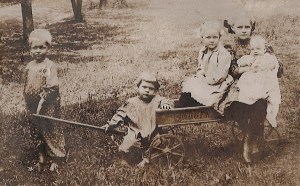
Florence was a hard worker. She would get up daily at 5am so that she could do her housework before the children woke up. Her habits probably aggravated her high blood pressure so that on October 17, 1919 she suffered her first stroke. She partially recovered from this stroke and was somewhat able to get around and do little things around the house.
The boys never finished school but got jobs as soon as they were old enough. The girls had to take care of the house and their invalid mother.
In 1928, in the midst of Prohibition, Edward and some friends decided to pool their efforts to make homemade corn whiskey. Instead of several small whiskey stills, they agreed to make one bigger one. Edward was caught and arrested for making more than was allowed for his consumption. He was tried in court for making boot-leg whiskey and sentenced to six months in jail.
Always a religious man, Edward requested permission to be allowed to attend Sunday Mass. This request was denied by the judge. Even a special appeal to be allowed to attend Christmas Mass was disallowed. This denial of his religious freedom was the severest part of his punishment. After his release, he always referred to his time in jail as a “vacation”.
In the fall of 1929, Florence had another stroke and became very much worse. Bed-ridden with her speech garbled, she could not always make herself understood. She became very impatient with her husband and children. She died three years later on October 31, 1932.
Edward was a man who loved his children. But he was also very strict with them. On one occasion, when his oldest daughter, Genevieve, was 14 years old, he spat tobacco juice on her bare feet and told her she was now too old to go bare-foot and to go put on some shoes and stockings. That was his way of telling her that she was no longer a child and must now act as an adult. He also loved his grandchildren and was not without a sense of humor. His granddaughter, Eleanor, he nicknamed her “Jinx” because she was always getting into mischief.
When Edward died in 1946, his two youngest children were still unmarried and living at home. Both were engaged to be married at the time and on the advice of their aunt, Sister Fidelis, a Catholic nun, they were married only two weeks after the death of their father. It was felt there might be a scandal if they were to live alone with no chaperone.
 Kiera's Genealogy Page